
Human–Automated Hybrid Misconduct (HAHM): How One False Entry Becomes “The System”
A Kapukai Governance Lab™ Public Explainer — Truth as Self-Evident™ Framework
Human–Automated Hybrid Misconduct (HAHM) explains a pattern millions of families have experienced but could never name: how a single false or coercive entry — a lie, omission, or misleading accusation — becomes replicated across automated systems until institutions treat it as truth.
This public explainer shows, in plain language, how HAHM works and why it drives systemic injustice across child protection, family courts, public benefits, policing, immigration, and other bureaucratic environments.
What Is HAHM?
Human–Automated Hybrid Misconduct (HAHM) describes a simple but dangerous pattern:
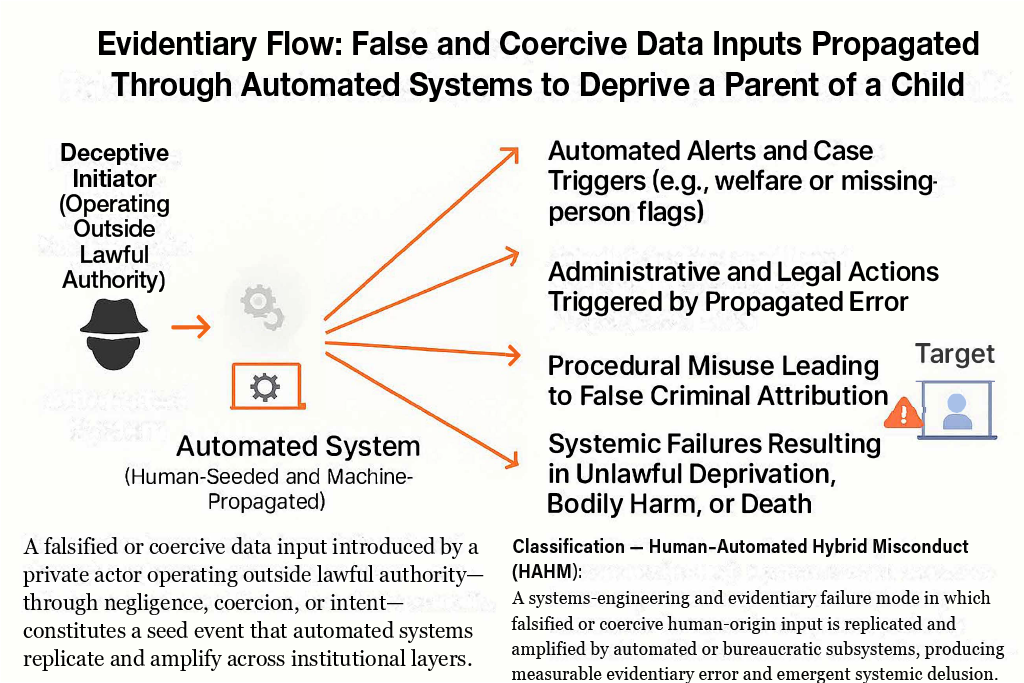
A human-origin falsehood enters a database or bureaucratic process once, and automated systems then treat it as true, copy it everywhere, and act on it as if it were independently verified. In other words, a single bad entry — whether negligent, coerced, or intentional — is amplified by machines and procedures until it starts to look like the system itself is confirming the lie. Families and targeted individuals then face surveillance, loss of rights, or wrongful accusations that are extremely hard to unwind.
This explainer is the plain-language companion to the full technical exhibit, “Human–Automated Hybrid Misconduct (HAHM): Quantifying Evidentiary Error Propagation in Automated Systems”, authored by Christine Kanoelehua Hillier for Kapukai Governance Lab™.
The Basic Mechanism
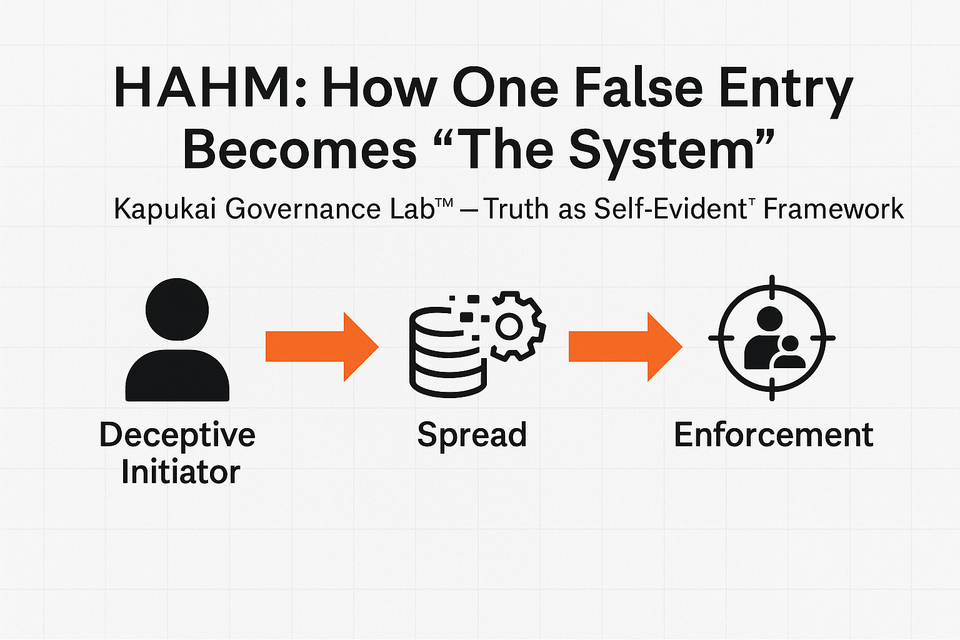
We can think of HAHM in three steps:
- Seed: A false or misleading entry is introduced by a person (for example, a falsified report, a misleading affidavit, or an omission of important corrective facts).
- Spread: Automated systems treat that entry as reliable and copy it into other databases, case-management tools, alerts, and forms. Each new document looks like independent confirmation, even though all of them come from the same original error.
- Enforcement: Agencies and institutions rely on these replicated records to make decisions: opening investigations, flagging a parent as dangerous, limiting contact with a child, or denying remedy. The falsehood gains power purely by being repeated.
HAHM is not just a technology problem. It is a governance problem: how institutions decide what counts as evidence, how they validate data, and how quickly they can correct their own mistakes.
Why It Matters for Families and Rights
When this pattern plays out in child protection, family courts, public benefits, or immigration systems, the consequences are severe:
- A parent is wrongly flagged as a flight risk or abuser and treated that way by every agency that imports the record.
- A family is denied basic due process because internal documents all repeat and reinforce the same uncorrected error.
- Appeals and complaints are routed through channels that rely on the very records being challenged.
From the outside, it can look as if “every part of the system agrees.” In reality, many parts of the system are simply repeating the same unverified input.
Mechanical Failure, Not Just “Bad Actors”
HAHM is a mechanical failure mode in socio-technical systems:
- The false input is human.
- The mass replication is automated.
- The institutional failure to detect and correct the error is systemic.
This mix of human intent and machine repetition creates what Kapukai Governance Lab™ calls an emergent state of systemic delusion: people inside the system sincerely believe they are acting on solid evidence, even when that evidence traces back to a single unverified or coercive entry.
The “No Remedy” Problem
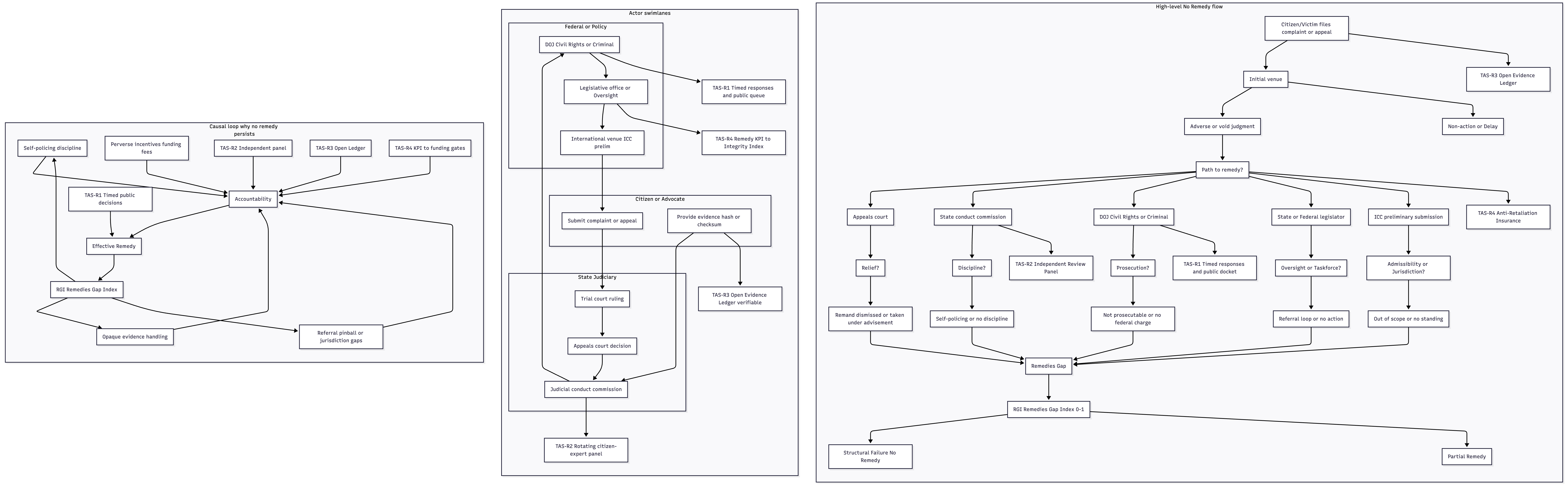
In many HAHM cases, people discover that there is effectively no legal remedy:
- Appeals are denied without ever reaching the core error.
- Complaints about misconduct are routed back to the same agencies that rely on the corrupted data.
- Requests for transcripts or records are delayed, restricted, or refused.
Kapukai Governance Lab™ models this as a Remedies Gap: a measurable pattern where all formal channels for correction either fail, stall, or retaliate. When that gap is widespread, it becomes evidence that the system is structurally dampening truth instead of correcting it.
What Truth Architecture Adds
The Kapukai Governance Lab™ framework, Truth as Self-Evident™, applies engineering standards — like reproducibility, measurability, and auditability — to legal evidence and institutional decision-making.
In the HAHM context, that means:
- Requiring clear data provenance: Where did every factual claim come from?
- Ensuring independent verification: No automated propagation without human checks at key points.
- Building remedy guarantees: Timelines, escalation paths, and anti-retaliation protections that can be measured and enforced.
When truth is treated as something that must be measurable, insurable, and reproducible, systems can no longer hide behind complexity. Either they can show how a decision was built from verified facts, or they must admit uncertainty and correct course.
How This Explainer Can Be Used
This public explainer is designed so that:
- Families and advocates can name the pattern they are experiencing.
- Journalists and researchers can recognize HAHM in different sectors.
- Policy-makers and courts can see why purely technical fixes are not enough.
For full technical detail, including formal definitions, validation concepts, and references to national and international guidance, see the companion exhibit:
Human–Automated Hybrid Misconduct (HAHM): Quantifying Evidentiary Error Propagation in Automated Systems (Kapukai Governance Lab™).
Intellectual Property Notice
The HAHM model and Truth as Self-Evident™ framework remain the intellectual property of Kihei Light Holdings LLC. This public explainer may be shared for educational and advocacy purposes, but it does not grant any license for commercial use or for derivative systems without express written permission.
Contact: architect@kapukai.org
A full technical exhibit (HAHM: Quantifying Evidentiary Error Propagation) will be available soon for Kapukai Sovereign Access members.